Website optimisation is evolving. The sacred SEO now coexists with GEO. We have been taught for years to build pages with a structure and keywords, but today the various LLMs no longer use this approach: they seek answers to very specific questions. And it is by answering these questions that your site (or brand) will be highlighted in the responses of ChatGPT, Claude, Perplexity, Gemini, or other AI players.
On 21/04/2026, it is Semjuice who explains, at the CCI Hérault premises in Mauguio, how to be effective in building web pages so that one can be properly visible to AI engines.
The difference between SEO and GEO
SEO has always aimed to guide the internet user who knew what they were looking for (e.g., "Sushi restaurant Montpellier") while GEO will help the internet user in their thinking (e.g., "which nice restaurant in Montpellier, quiet, for a business meal?")
How to optimise your website for GEO
First, you need to identify the thematic universe of our brand, of our offer. Then, we build the site around this theme and potential questions related to this universe. The conversational engine will then identify the answers we provide to these questions and will use our content to respond to the internet user. It will be even more effective if we build pages with short, structured blocks that the LLMs can take in full.
We return to a fundamental point: the reason for the brand's existence and the associated marketing that must take precedence over the simple visibility that we have been seeking until now with SEO.
Conclusion on the GEO
In the age of AI, we return to a more human, more marketing-oriented approach in that the articles published on the pages of our site will now, as far as possible:
- be enriched with sourced data
- highlight comparisons
- support statements with figures
- quote individuals or have clients testify
The LLM wants to provide an answer to a user who has requested it and cannot settle for approximate data and beautifully rich semantic phrases; it wants concrete evidence, and if your site is seen as an authority on the subject, then your brand will be highlighted. SEO is not dead yet, and 'classic' searches persist, but we must prepare to revise the content of websites so that the content can be optimised for LLMs.
Odoo and the GEO
The writing of web pages or blog articles in Odoo already benefits from an SEO analysis (presence of hierarchical titles and keywords) and can assist us with certain features via AI assistance:
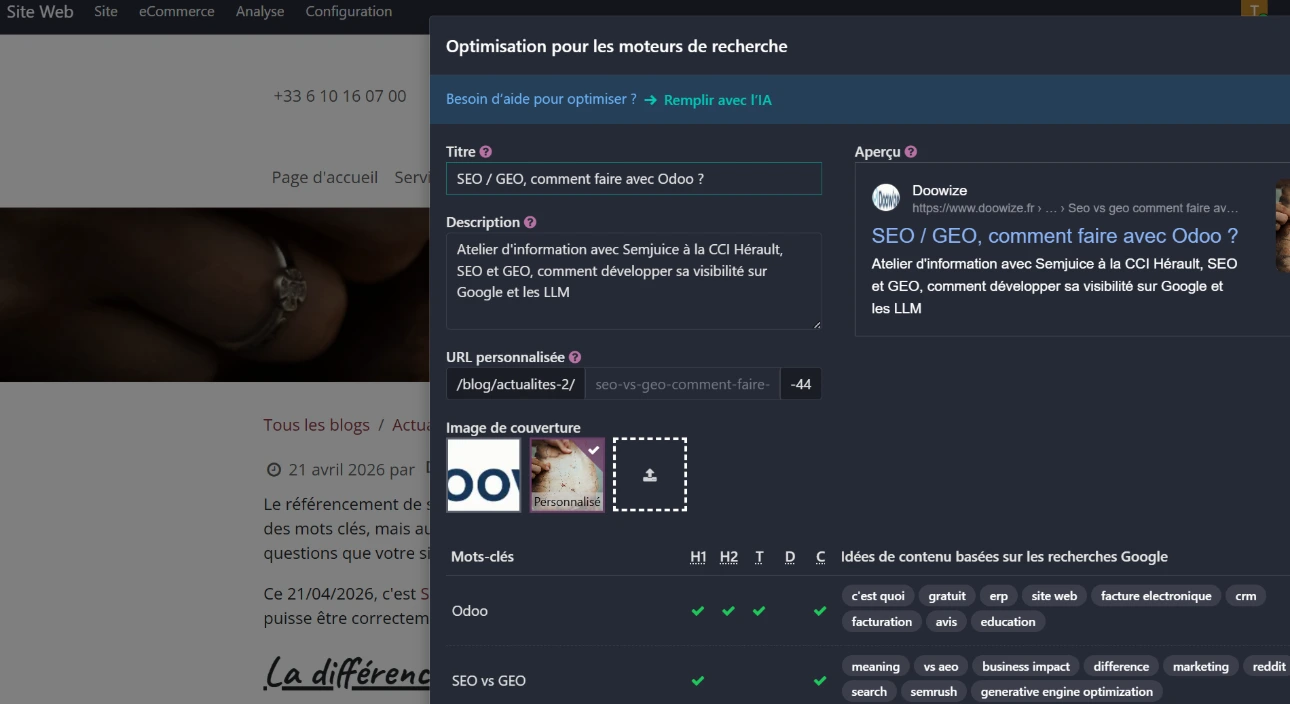
But the analysis of the brand's universe is not yet native and Odoo does not offer a page construction that is GEO-oriented, and that's a good thing. Indeed, the very essence of the brand, the added value brought by the company can only be highlighted by the company itself, and by a dedicated editorial team. This humanisation prevents the publication of hollow and insipid content, which LLMs would not find interesting anyway...
What tools to optimise your website?
I use Screamingfrog to analyse in detail the content of my website and detect anomalies (titles that are too long or too short, images that are too heavy, H1/H2 structures in error, etc.)